1.What is transformer?
A transformer is a static electrical device that transfers electrical energy between two or more circuits through electromagnetic induction without any electrical connection between the circuits.
2. What is the principle of transformer?
Mutual inductance
3. What is mutual inductance?
Mutual induction is defined as the current flowing in one coil that induces a voltage in an adjacent coil.
4. What are the types of transformer based on the voltage levels?
- Step up transformer
- Step down transformer
5. What are the types of transformer based on the core medium used?
- Air core transformer
- Iron core transformer
6. What are the types of transformer based on the core arrangement?
- Core type
- Shell type
7. What are the other common types of transformer?
- Auto transformer
- Variable frequency transformer
- Resonant transformer
- Power transformer
- Distribution transformer
- Isolating transformer
- Instrument transformer
8. How to calculate the emf induced in the transformer?
According to Faraday’s laws, “The Rate of change of flux linkage with respect to time is directly proportional to the EMF induced in a conductor or coil”.
E= N dϕ /dt
 Efficiency of an ideal transformer is Pin = Pout, Pin/ Pout = 1.
24. How to calculate the power of transformer?
 ΦP and ΦS - primary and secondary phase angle.
E= N dϕ /dt
Where,
E = Induced EMF
N = the number of turns
dϕ = Change in flux
dt = Change in time
E = Induced EMF
N = the number of turns
dϕ = Change in flux
dt = Change in time
9. What is step up transformer?
In step up transformer, the output voltage is made greater than the input voltage by increasing the number of windings in the secondary than the primary windings.
Vo > Vin
10. What is step down transformer?
In step down transformer, the input voltage is made greater than the output voltage by increasing the number of windings in the primary than the secondary windings.
Vin > Vo
11. What is air core transformer?
Both the primary and secondary windings are wound on a non-magnetic strip where the flux linkage between primary and secondary windings is through the air.
12. What is iron core transformer?
Both the primary and secondary windings are wound on multiple iron plate bunch which provide a perfect linkage path to the generated flux. It has high efficiency and reluctance than air core transformer.
13. What is auto-transformer?
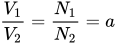
Auto transformer is a transformer with single winding. It has common winding for both primary and secondary winding where the number of turns can be adjusted by tapping.However the voltage and current ratio of auto transformers can be formulated the same as other two-winding transformers by:
14. What is power transformer?
Power transformer are used in power station where the high voltage (greater than 33KV) can be used.
15. What is Distribution transformer?
Distribution transformer is used to distribute power from generation station to the remote location. It has the voltage range of 440v-220v.
16. What are the types of Instrument transformer?
19. What is transformer turns ratio?
 For an ideal transformer : ΦP ≡ ΦS
13. What is auto-transformer?
Auto transformer is a transformer with single winding. It has common winding for both primary and secondary winding where the number of turns can be adjusted by tapping.However the voltage and current ratio of auto transformers can be formulated the same as other two-winding transformers by:
14. What is power transformer?
Power transformer are used in power station where the high voltage (greater than 33KV) can be used.
15. What is Distribution transformer?
Distribution transformer is used to distribute power from generation station to the remote location. It has the voltage range of 440v-220v.
16. What are the types of Instrument transformer?
- Current transformer
- Potential transformer
17. What is Current transformer?
Current transformer is a series connected measurement device used to measure high AC current. It produces current in the secondary coil directly proportional to the current in the primary coil.
18. What is potential transformer?
Potential transformer is a parallel connected measurement device used to measure high voltage.
It is also called as voltage transformer. The primary winding consists of a large number of turns which is connected across the high voltage side. The secondary winding has lesser number of turns which is connected across the voltmeters, or potential coils of wattmeter and energy meters, relays and other control devices.19. What is transformer turns ratio?
Where,
Np - number of primary turns
Ns - number of secondary turns
Vp - voltage of primary coil
Vs - voltage of secondary coil
n - number of turns
ΦP - flux in the primary coil
ΦS - flux in the secondary coil
20. What happens if transformer is connected to the DC supply?
If transformer's primary winding is connected to the DC supply, no inductive reluctance will be produced as DC has no frequency. so no emf will be induced in the secondary winding. Hence transformer don't work on DC.
21. How the transformer ratings are measured?
Transformer ratings are measured in Volt-ampere, this is obtained by multiplying current by voltage. It can also be expressed in KVA(Kilo volt ampere), MVA (Mega volt ampere).
22. What is an ideal transformer?
In ideal transformer, the number of turns in primary coil is equal to the number of turns in secondary coil. Hence the power ratio of an ideal transformer is 1.
23. What is efficiency in transformer?
Transformer efficiency is defined as the secondary coil output to the primary coil input.
24. How to calculate the power of transformer?
Comments
Post a Comment